On Monday I was invited to speak to Camden Cycling Campaign (Camden LCC ) on the subject: Going Dutch: Let's clarify what we think this means. This followed the 54% vote for "Going Dutch"in the LCC poll on its options for its main campaign for the 2012 mayoral elections.
I was keen to avoid having a re-run of the endless "theological" argument that UK cycle campaigners can get into on the principle of whether cyclists should be integrated with, or separated from, motor traffic. That, in my book, is all very old hat. LCC has had its vote, and the result was that most members wish LCC to campaign for Dutch-style cycling. That means separation from fast or heavy motor vehicle flows. In the event it was a productive discussion that avoided the "theology" but focussed on the questions of how, in practice, politically, can we work in London to get started on building a network of high-quality segregated cycle tracks, where should we start, and what should Camden Cycling Campaign be asking Camden Council for? Jean Dollimore has written-up an account of the discussion , so I don't need to repeat it here.
Camden Cycling Campaign pioneered on-road Dutch-style segregated cycle tracks in London in the early 2000s with their designs for the Somers Town (Royal College Street) and Bloomsbury cycle routes (the latter only partially implemented), as I have covered extensively before . Now that LCC has decided that it wishes to campaign concertedly, as a whole, for this type of infrastructure, it makes sense for local groups to start working to identify which would be the best candidate roads in their boroughs.
The best candidate in Camden, the meeting concluded, is Tottenham Court Road. This is already part of, or connected with, several cycle routes of varying quality, most importantly the Bloomsbury track (LCN+ route 0 in Torrington Place, Maple Street and Howland Street), and it is, of course, a key N-S axis route for central London, with currently high levels of cycling. Moreover, Camden Council, in their 2011 Transport Strategy , already have a plan for this road. The plan proposes:
Introduction of public realm improvements and 2-way traffic along Tottenham Court Road (cycle and buses only) and Gower Street. The scheme would improve journey times for buses, the attractiveness of streets, pedestrian and cycling facilities, and help to remove the queue of buses on New Oxford Street.

|
| Tottenham Court Road now |

|
| Camden's artist's impression of the future Tottenham Court Road |
Realistically, I can't see Camden succeeding politically in removing black cabs from Tottenham Court Road. There will also need to be lorries delivering to the shops (as seen in the "current" photo). So it will not look quite as rosy as in the artist's impression. In fact, it may be significantly less rosy. If we have large numbers of buses and black cabs directed on to a two-way Tottenham Court Road, plus the servicing of businesses, plus private cars and minicabs that go that way anyway, because nothing physically stops them, then the result could be very like Oxford Street – not a pleasant road for cycling on.
Even assuming Camden can go so thoroughly against the thrust of current TfL policy as to severely reduce the space for cars and exclude all but buses and bikes from Tottenham Court Road, according to David Hembrow , there is nothing like having to share space with buses for reducing the feeling of subjective safety for cyclists. I agree with him. The constant "swapping over" game when you have to overtake a bus at a stop, judging whether or not it is suddenly going to take off again, then it does, just after you have passed it, and it overtakes you again, and stops in front of you again, all this is deeply tiresome and offputting to all but hard-core cyclists. Particularly on routes where there are large numbers of buses, or they where can travel fast, buses and cyclists need to be separated to create an attractive cycling environment.
In the Camden artist's impression, with the space-wasting central strip in the road, there appears not to be enough space for buses to overtake cyclists with good clearance. This will result in cyclists having to compete with buses for space, "taking the lane" (as indeed the artist has shown) and potentially suffering aggression from bus drivers behind. Children, old people, the unfit, those on cargo bikes, and many other potential cyclists, do not want to, or simply cannot, adopt a cycling style that requires them to "take the lane" in order to act as human traffic calming in front of a 10 ton vehicle travelling at 20mph or more. This simply is not a quality cycling environment, however sunnily and cheerfully the artist has rendered the picture.
This is exactly the kind of high-profile location where we need "Dutch" facilities, where there are many people passing through, pedestrians and bus users who, if this were done, would see for the first time in a British city cycling being taken really seriously in urban planning, and a good proportion of whom would then think: "Yes! I might try that". This is not a case of needing to spend loads of money on cycling. Camden are going to have to spend a tidy sum to change the road in the way they are planning anyway. To incorporate international-standard cycle tracks would probably hardly affect their calculations at all.
There are still many UK cyclists who don't see the need for segregated cycle tracks. They sometimes say to me, "We are doing fine as it is. Cycling is increasing in London; we don't need lots of money spent on elaborate street engineering".
Some graphics in the Camden Transport Plan show clearly, however, what the problem is. Yes, cycling in Camden, as measured by screenline counts, has increased quite a bit in recent years. Here is the graph.

|
| Traffic in Camden |
Cycling traffic (though not necessarily
number of cyclists
, or cycling mode share) has increased by 100% in 8 years in Camden. And to what level, exactly?
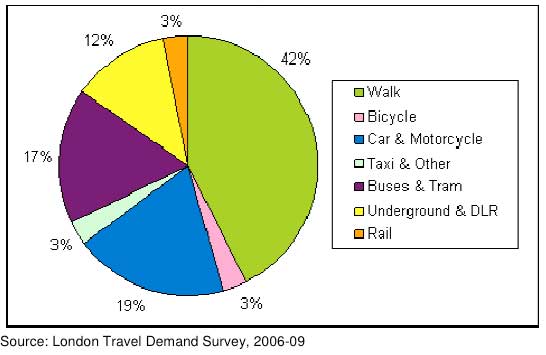
|
| Mode share in Camden |
To a 3% mode share, that's what. To the dizzy heights of 3% – what
Freewheeler
would call a "risible modal share". That's good for London and high for the UK. But it's a long way from Copenhagen's 40%, or Groningen's 50%. It's not a "critical mass" or close to any kind of breakthrough point. And looking at the trend, seeing that on aggregate there was almost no change between 2006 and 2009, it looks like the increase was due to factors in place before 2006 (the main one almost certainly being the Congestion Charge, introduced in 2003), and that it has now levelled off. There's been a huge emphasis on encouraging cycling in Camden. The new Transport Plan is full of pictures of bikes and stuff about cycling, as have been many previous Camden publications. Camden has been one of the most pro-cycling local authorities in the UK over a long period. And the result of all that effort has been that cycling has remained very marginal in Camden – a borough which includes a large part of the centre of London.
And here's the problem:

|
| Road casualties in Camden, 2008 |
The 3% mode suffers 19% of the casualties, that's the problem. Cycling in Camden, as in the rest of the UK, is
too dangerous
. That's why more people won't do it, however you try to encourage them.
The answer is to change the infrastructure. You need to make cycling feel safe, and actually be safe, and convenient, at the same time. Quality segregated infrastructure achieves this. It gives
high levels of real safety
along with a pleasant environment and a high priority for cycle movement. Camden already has some segregated infrastructure, but it's very limited. It's on nothing like the scale you find in any city in the Netherlands, Denmark, or in many cities in Germany. Camden, and the rest of London, needs more and better (and better-located) segregated infrastructure to start to approach mass cycling. Tottenham Court Road would be a good place to start.
I hope LCC has learned from the segregated cycle routes that you've mentioned since they have a lot of design problems - I remember that you explained why they exist, but it's a chance to up the game a little and avoid things like curbing off the cycle track in favour of rising it a few inches from the road.
ReplyYou see both kerbed and raised designs in various cities on the continent. My feeling is that on a major road with a lot of shops, like Tottenham Court Rd, there is going to be strong pressure for parking and taxi/van stopping on the track, and therefore a hard kerb is a better design to prevent this.
ReplyI must say, I haven't seen a kerbed design in the dutch guidelines, at least not in a sens that there would be a 6" wide and 6" high kerb on both sides. To me this kind of design is actually potentially dangerous - any kind of obstacle that you might want to avoid will take you either into the oncoming bicycle traffic or on a high kerb.
ReplyThis is my main concern here - if we are going dutch, let's not try to pretend that we know better but use the dutch guidelines. IMHO.
Not sure I follow you, ndru. I don't see what the obstacle is you are referring to.
ReplyAny kind of obstacle David. If the track is kerbed of on both sides you can neither avoid collisions nor easily get on the pavement to park or on road to make a turn. I am simply trying to point out that if we are really going Dutch we should adopt the Dutch standards. Cable street is simply raised and you don't seem to get people parking there.
ReplyYou know ndru, if you want to park, you stop, get off your bike and then take it up over the kerb onto the pavement, a trick learned generations ago by millions of Dutch and Danish cyclists.
Also, on a 2-2.5m cycle track you have plenty of space to avoid "obstacles".
alternatively, there's the kind of set-up in the picture with this article
Replyhttp://www.nytimes.com/2011/08/17/nyregion/effort-to-remove-prospect-park-west-bike-lane-is-rejected.html
i tend to agree that big kerbs (especially with narrowish lanes) can easily send you arse-over-tit if someone coming the other way has a moment's inattention (or you do..)
London cycling blogs are so depressing, even when the authors are trying to positive it's still depressing. I shall steer clear in future and stick to cycling in London rather than reading about how we all get shaken up regularly.
Reply